5 Breathing Exercises to Lower Blood Pressure

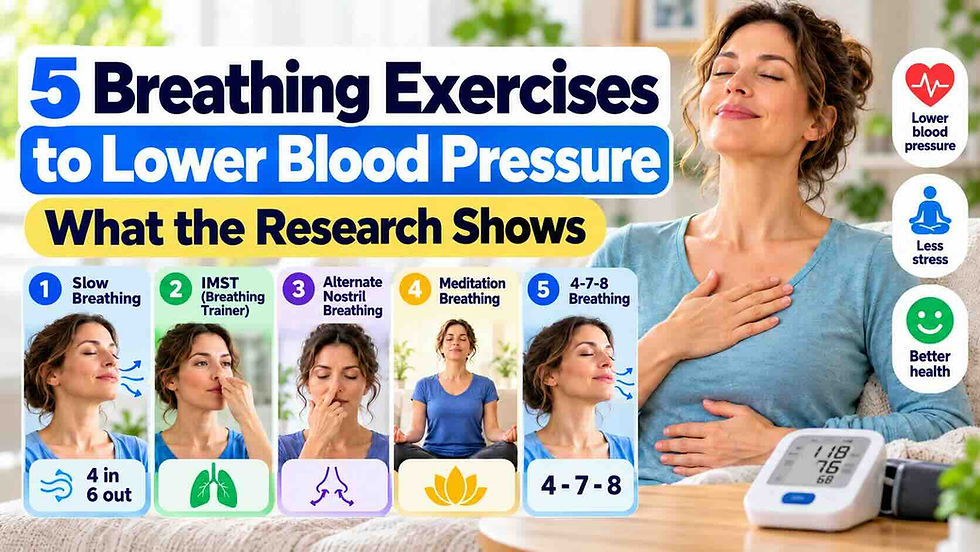
It is science proven: breathing exercises help to lower blood pressure. The strongest support is for slow paced breathing and high-resistance IMST. Alternate-nostril breathing, breath-focused meditation and 4-7-8 are promising. The 2025 ACC/AHA guideline lists breathing control as a reasonable adjunct to lifestyle or medication to address hypertension.
📊 5 Breathing Exercises to Lower Blood Pressure Compared
Method | How to perform it | Evidence for lowering BP | Typical session | Main cautions |
Slow paced breathing ≈6 breaths/min | Breathe gently at about one breath every 10 seconds: inhale 4 sec + exhale 6 sec | ⭐⭐⭐⭐ Strong | 5–15 min/day | Don't force deep breaths |
High-resistance IMST | Take 30 strong inhalations against inspiratory resistance | ⭐⭐⭐⭐ Strong | ~5–8 min, 5–6 days/week | Can be performed either with a device or without (lower accuracy) |
Alternate-nostril breathing | Gently alternate breathing through the left and right nostrils | ⭐⭐⭐ Moderate | ~10 min, 1–2×/day | Evidence is heterogeneous; avoid forcing blocked nostrils |
Breath-focused meditation | Breathe slowly and repeatedly return attention to the breath | ⭐⭐⭐ Moderate | 10–20 min/day | BP evidence often comes from broader meditation programs |
4-7-8 breathing | Inhale 4 sec → hold 7 sec → exhale 8 sec | ⭐⭐ Emerging for BP | 4–6 cycles, ~2–3 min | Direct BP evidence is emerging |
My practical choice for most beginners: start with comfortable slow breathing at around 6 breaths per minute.
Best time-efficient technique with strong clinical BP evidence: high-resistance IMST.
🔬 What Does the Research Say About Breathing and Blood Pressure?
A systematic review and meta-analysis of 15 randomized studies found that breathing exercises reduced blood pressure on average by approximately:
📉 −7.06 mmHg systolic
📉 −3.43 mmHg diastolic
Heart rate also declined modestly.
The authors concluded:
“There is a moderate but significant positive effect.”
The studies included several different breathing methods.
The 2025 ACC/AHA hypertension guideline also now includes breathing control among stress-management interventions that may reasonably be used alongside other lifestyle changes or medication.
Its evidence table estimates an average systolic BP reduction of around 5 mmHg from breathing control and describes a typical target as slowing respiration to fewer than 10 breaths per minute for about 15 minutes per day.
1. 🫁 Slow Paced Breathing at About 6 Breaths per Minute
If your goal is specifically blood pressure, this is the technique I would put first.
The idea is simple:
Slow your breathing to roughly one breath every 10 seconds.
A comfortable pattern might be:
Inhale gently for 4 seconds → exhale gently for 6 seconds.
That equals about 6 breaths per minute.
You do not need to inhale as deeply as possible.
The goal is slow, comfortable breathing, not maximum lung inflation.
Why Slow Breathing May Lower Blood Pressure
Blood pressure is partly regulated by the autonomic nervous system and the baroreflex—the body's rapid feedback system for stabilizing pressure.
A classic study of people with essential hypertension found that breathing at six breaths per minute improved baroreflex sensitivity and reduced blood pressure.
The researchers explained:
“Slow breathing at 6 breaths/min increases baroreflex sensitivity and reduces sympathetic activity.”
In another randomized study of older adults with controlled isolated systolic hypertension, participants trained at six breaths per minute for 30 minutes per day for eight weeks, with both loaded and unloaded slow-breathing groups studied.
Evidence strength: ⭐⭐⭐⭐ Strong
Slow breathing is supported by mechanistic studies, randomized trials, pooled breathing-exercise data and current hypertension guidance.
⏱️ A Simple 10-Minute Slow-Breathing Protocol
Sit comfortably with your back supported.
Relax your shoulders and breathe normally for about one minute.
Inhale gently through your nose for about 4 seconds.
Exhale comfortably for about 6 seconds.
Repeat for 5–10 minutes, keeping the breathing smooth rather than excessively deep.
If 4/6 feels uncomfortable, use another comfortable rhythm that keeps your breathing slow.
Stop if you feel dizzy or short of breath.
A recent comparison of several breathing patterns found that six-breaths-per-minute breathing increased HRV more than 4-7-8 or square breathing, although some participants showed mild over-breathing.
For more about the six-breaths-per-minute approach and recent research on slow breathing, see our deeper article:
2. 💨 High-Resistance Inspiratory Muscle Strength Training — IMST
IMST is very different from relaxing slow breathing.
Instead of simply slowing respiration, you inhale forcefully against resistance.
Think of it as:
💪 Strength training for your breathing muscles.
This is also one of the most interesting breathing interventions for blood pressure because it requires only a few minutes per day.
What the IMST Research Found
A double-blind randomized sham-controlled trial studied adults aged 50–79 with above-normal systolic BP.
Participants completed:
30 resisted breaths per day
6 days per week
6 weeks
with resistance progressing to approximately 75% of maximal inspiratory pressure.
Average casual systolic BP fell from:
135 → 126 mmHg
and approximately 75% of the improvement remained six weeks after training stopped.
The authors concluded that IMST was:
“a safe, highly adherable lifestyle intervention for improving blood pressure and endothelial function”
The trial also reported an approximately 45% improvement in brachial artery flow-mediated dilation, a measure of endothelial function.
More recently, an eight-week randomized study in people with hypertension reported systolic reductions of approximately 9.1 mmHg with IMST versus 6.2 mmHg with aerobic exercise, although the study was small and the longer-term persistence of the IMST benefit remained uncertain.
You can also perform IMST breathing without a device though it will be somewhat less effective. For the complete protocol, see:
Evidence strength: ⭐⭐⭐⭐ Strong
3. 👃 Alternate-Nostril Breathing
Alternate-nostril breathing—often called Nadi Shodhana or Anulom Vilom—comes from traditional yoga breathing practices.
The basic approach is:
👃 Gently close one nostril.
🫁 Inhale through the open nostril.
🔄 Switch sides.
💨 Exhale through the opposite nostril.
Then reverse the sequence.
Unlike aggressive pranayama practices, the BP-oriented version should be slow and comfortable.
What the Research Shows
A 2024 systematic review examined 14 studies, with six randomized trials included in its meta-analysis.
Across those six trials involving 525 participants, alternate-nostril breathing was associated with approximately:
📉 −7.16 mmHg systolic
📉 −5.16 mmHg diastolic
compared with non-intervention or placebo controls.
The review concluded:
“ANB can improve cardiovascular indicators, such as SBP and DBP”
The signal is promising, but I would not assume the impressive pooled BP reductions will occur in every person. Try approximately 5–10 minutes of gentle alternate-nostril breathing if you enjoy the technique.Don't force air through a blocked nostril and stop if you become uncomfortable or light-headed.
Evidence strength: ⭐⭐⭐ Moderate
4. 🧘 Breath-Focused Meditation
Meditation is not purely a breathing exercise.
But for many people, the easiest meditation technique is simply:
Pay attention to your breathing.
Sit comfortably.
Allow your breathing to become calm.
Notice each inhalation and exhalation.
When your attention wanders, gently return it to the breath.
This simultaneously changes two variables relevant to BP:
🫁 Breathing pattern
and
🧠 Psychological stress.
What the Research Shows
A randomized clinical trial assigned adults with elevated BP to eight weeks of mindfulness-based stress reduction (MBSR) or progressive muscle relaxation.
The MBSR group experienced a:
4.8 mmHg reduction in clinic systolic BP
versus 0.7 mmHg in the control group.
Diastolic BP also improved.
The researchers concluded:
“MBSR resulted in a reduction in clinic SBP and DBP compared with PMR.”
The 2025 ACC/AHA guideline recognizes meditation and breathing control as potentially useful adjuncts, rather than first-line replacements for proven lifestyle or medical therapy.
A practical starting point is:
🧘 10 minutes per day.
Sit comfortably, follow the breath and repeatedly return your attention to it without trying to suppress thoughts. For a deeper guide, see:
Evidence strength: ⭐⭐⭐ Moderate
5. 😮💨 4-7-8 Breathing
4-7-8 breathing is probably the best-known structured relaxation technique in this list.
One cycle is:
🫁 Inhale — 4 seconds
⏸️ Hold — 7 seconds
💨 Exhale — 8 seconds
The long exhalation makes the breathing very slow, while the counting provides a simple point of focus. Many people find it relaxing.
What New Research Says About 4-7-8 Breathing
A 2025 study directly compared:
4-7-8 breathing
square breathing
six breaths per minute using a 4:6 ratio
six breaths per minute using a 5:5 ratio
in 84 participants.
Six-breaths-per-minute breathing produced larger increases in HRV than 4-7-8 breathing.
Use 4-7-8 primarily as a relaxation technique, especially if you enjoy its structure and extended exhalation.
A simple session is 4–6 cycles.
For the detailed method, see:
Evidence strength for directly lowering BP: ⭐⭐ Emerging
⚠️ What About Breath Holding?
This deserves its own section because people often assume:
If slow breathing is beneficial, holding your breath for longer must be even better.
That conclusion is not 100% correct. Breath holding is likely to raise blood pressure short term.
However when done gently and progressively, breath-holding exercises can improve breathing efficiency aned support cardiovascular health. These ideas are most famously explained by Patrick McKeown in his book "The Oxygen Advantage".
Before trying breath holding please study our detailed discussion here:
🏆 Which Breathing Exercise Is Best for High Blood Pressure?
For most people interested specifically in blood pressure, I would rank the choices this way:
🥇 Best starting point: Slow breathing around 6 breaths/minute
Simple, free and supported by both physiological research and broader randomized-trial evidence.
🥈 Strongest time-efficient training option: IMST
Particularly interesting if you want a structured five-minute intervention.
🥉 Useful alternatives: Alternate-nostril breathing and meditation
Both may help, particularly when stress contributes to elevated BP.
😌 Best used mainly for relaxation: 4-7-8
Easy to learn, but direct evidence for BP reduction is currently emerging.
📱 Can a Breathing App Help?
The challenge with breathing exercises is rarely understanding what “breathe slowly” means.
The challenge is:
Doing it consistently.
A breathing app can:
⏱️ Control the inhale/exhale timing
🫁 Keep your respiratory rate consistent
🔔 Remind you to practice
⌚ Guide sessions on a smartwatch
📊 Help connect breathing practice with health data
Different apps specialize in different approaches.
We compared them here:
❤️ How BreathNow Connects Breathing With Blood Pressure
My own experience managing elevated blood pressure was one of the reasons we created BreathNow.
Rather than treating breathing as an isolated relaxation exercise, we wanted to connect:
🫁 Guided slow breathing
❤️ HRV and stress information
📊 Blood-pressure tracking
⌚ Apple Watch guidance
🚶 Exercise and activity
🤖 Personalized AI coaching
into one workflow.
Try BreathNow . One feature I find particularly useful is guided pacing: instead of watching a clock and manually counting seconds, the app provides visual guidance through each breathing cycle.
📊 How to Test Whether Breathing Is Helping Your Blood Pressure
Do not judge the technique from one unusually good measurement.
Blood pressure fluctuates naturally.
A better personal experiment is:
Measure your BP correctly under consistent resting conditions.
Choose one breathing technique rather than changing techniques every day.
Practice it consistently for several weeks.
Continue measuring BP under the same conditions.
Compare your average readings and trends, not your lowest individual result.
If you take antihypertensive medication, continue taking it as prescribed unless your healthcare professional changes your treatment.
🚨 Breathing Is Not Emergency Treatment for Very High Blood Pressure
If your BP is extremely high, do not attempt to “breathe the number down” instead of obtaining appropriate medical care.
A reading above 180/120 mmHg, particularly with symptoms such as:
❤️ chest pain
😮💨 shortness of breath
🧠 confusion
💪 weakness or numbness
👁️ vision changes
🗣️ difficulty speaking
can require urgent medical assessment.
Breathing exercises are best understood as a regular supportive habit, not emergency hypertension treatment.
❓ Frequently Asked Questions (FAQs)
1. Can breathing exercises really lower blood pressure?
Yes, randomized trials and meta-analyses suggest that some breathing interventions can produce modest reductions in blood pressure when practiced regularly. The size of the effect varies substantially depending on the technique and duration of practice.
2. What is the best breathing exercise to lower blood pressure?
For most beginners, comfortable slow breathing at approximately six breaths per minute has one of the clearest combinations of practicality and scientific support. High-resistance IMST also has strong clinical evidence but requires a resistance device to reproduce the research protocol.
3. How many breaths per minute are best for lowering blood pressure?
Many studies use approximately six breaths per minute, while the 2025 ACC/AHA guideline describes breathing-control interventions targeting fewer than 10 breaths per minute. There is no evidence that exactly six breaths per minute is optimal for every individual, so breathing should remain comfortable.
4. How long should I practice breathing exercises?
A practical starting point is 5–10 minutes per day, while some clinical breathing-control protocols use approximately 15 minutes daily. IMST is different and typically involves about 30 resisted breaths over roughly five to eight minutes.
5. Does 4-7-8 breathing lower blood pressure?
The precise 4-7-8 pattern has much less direct BP evidence than slow breathing in general. The new evidence of the efficacy of this breathing technique is emerging.
6. Does IMST lower blood pressure?
Yes, randomized trials have reported meaningful systolic BP reductions after several weeks of high-resistance IMST. You can perform IMST breathing with or without a device
7. Can meditation lower blood pressure?
Some randomized studies show modest clinic BP reductions with structured mindfulness or meditation programs. Meditation should be viewed as a complementary stress-management strategy rather than a replacement for proven hypertension treatment.
8. Is alternate-nostril breathing good for high blood pressure?
A 2024 meta-analysis found reductions in systolic and diastolic BP with alternate-nostril breathing. The studies were highly heterogeneous, the new evidence is emerging.
9. Is holding my breath good for high blood pressure?
Prolonged breath holding is not a recommended BP-lowering technique and can cause blood pressure to rise substantially. This is different from the brief comfortable pauses as explained in the 'Oxygen Advantage' book.
10. Can breathing exercises replace blood pressure medication?
No, breathing exercises should not be used to stop or replace prescribed antihypertensive medication without medical supervision. They are best considered one component of a broader strategy that can include diet, exercise, weight management, sleep, stress reduction and medication when indicated.
📚 Research References
1. Garg P et al. — Effect of Breathing Exercises on Blood Pressure and Heart Rate: A Systematic Review and Meta-AnalysisFifteen randomized studies were included; pooled reductions were approximately 7.1 mmHg systolic and 3.4 mmHg diastolic.PubMed
2. Joseph CN et al. — Slow Breathing Improves Arterial Baroreflex Sensitivity and Decreases Blood Pressure in Essential HypertensionA physiological study demonstrating beneficial BP and autonomic effects of breathing at six breaths per minute.PubMed
3. Craighead DH et al. — Time-Efficient Inspiratory Muscle Strength Training Lowers Blood PressureRandomized sham-controlled trial showing a roughly 9-mmHg fall in casual systolic BP after six weeks of high-resistance IMST.PubMed
4. Nam TG et al. — Effectiveness of Alternate Nostril Breathing on Blood Pressure: Systematic Review and Meta-Analysis of RCTsSix trials in the quantitative meta-analysis showed significant BP reductions, although study heterogeneity was high.PubMed
5. Hughes JW et al. — Randomized Controlled Trial of Mindfulness-Based Stress Reduction for PrehypertensionMBSR reduced clinic systolic and diastolic BP compared with progressive muscle relaxation.PubMed
6. Marchant J et al. — Comparing Square, 4-7-8 and 6 Breaths-per-Minute BreathingSix-breaths-per-minute breathing produced greater HRV changes than 4-7-8 or square breathing, but none produced meaningful acute BP changes.PubMed
7. 2025 ACC/AHA Multisociety High Blood Pressure GuidelineThe current guideline recognizes breathing control and meditation as potentially useful adjunctive stress-reduction strategies for elevated BP and hypertension.
Medical disclaimer: This article is for general education and does not provide medical diagnosis or individualized treatment. Breathing exercises should complement—not replace—appropriate blood-pressure monitoring, lifestyle treatment and medication recommended by your healthcare professional.