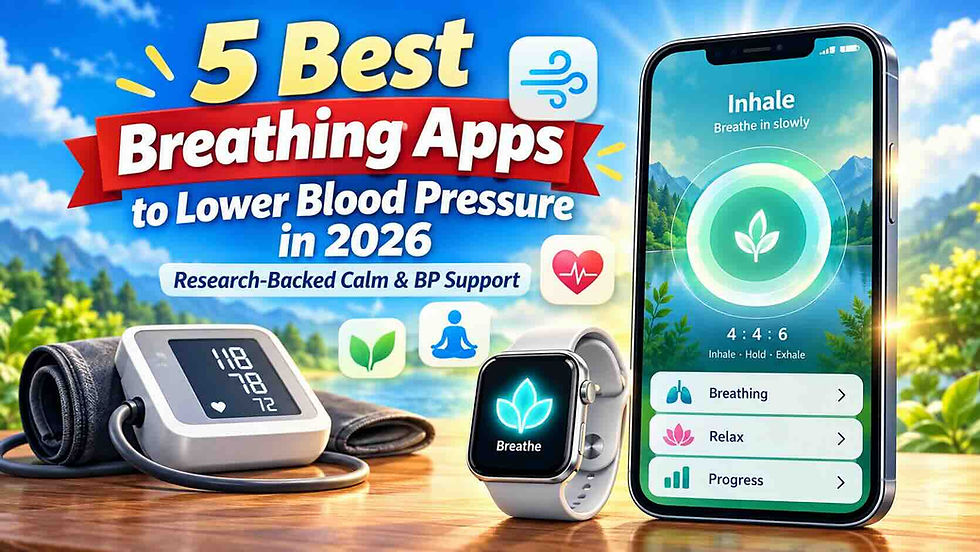
5 Best Breathing Apps to Lower Blood Pressure

Updated: Sep 26
Updated: September 2026 | By Dmitri Konash, PhD
What is the best app for breathing exercises to lower blood pressure? BreathNow is designed specifically around blood pressure, combining guided breathing with BP tracking, Apple Watch/Health Connect integration and an AI BP Coach. Breathwrk offers a large library of structured breathwork, iBreathe excels at simple customizable breathing, Paced Breathing provides precise control over breathing pace, and Breathe2Relax focuses on diaphragmatic breathing and stress management.
📊 Comparison: 5 Best Breathing Apps to Lower Blood Pressure
App | Best for | BP-specific breathing | BP tracking | AI BP Coach | Apple Watch | US App Store rating |
BP management + personalized guidance | ✅ | ✅ | ✅ Yes | ✅ | ⭐ 4.7/5 | |
Breathwrk | Large breathwork library + stress relief | ✅ Some BP-oriented exercises | ❌ | ❌ | ❌ Current listing is iPhone only | ⭐ 4.8/5 |
iBreathe | Simple customizable slow breathing | ⚠️ Useful patterns, not BP-centered | ❌ | ❌ | ✅ | ⭐ 4.9/5 |
Paced Breathing | Precisely customizable breathing pace | ⚠️ Cardiovascular-focused evidence | ❌ | ❌ | ❌ | ⭐ 4.9/5 |
Breathe2Relax | Diaphragmatic breathing + stress management | ⚠️ Indirect | ❌ | ❌ | ❌ | ⭐ 4.2/5 |
App Store ratings checked in September 2026 and can change. “BP-specific” means the app or developer explicitly connects breathing with blood-pressure or cardiovascular outcomes; it does not mean that an app is a hypertension treatment.
🤖 Key difference: Among these five apps, BreathNow is the only one that combines breathing exercises, blood-pressure tracking and a dedicated AI BP Coach in the same workflow.
🔍 How We Selected These Breathing Apps
We looked for apps that were both currently available and relevant to people searching for breathing exercises to lower blood pressure.
We considered six factors:
Relevance to slow or controlled breathing
Evidence or developer documentation connecting breathing with BP, cardiovascular health or stress regulation
Ease of following the breathing rhythm
Ability to personalize breathing duration or technique
Current app-store availability and public ratings
Features that provide value beyond a basic visual breathing timer
We also reviewed current search results, developer websites, US App Store listings and public app-store feedback.
Disclosure: BreathNow is developed by our company, Cardio Calm Ltd. We therefore identify our relationship clearly and evaluate the other apps using the same published criteria.
🥇 1. BreathNow — Best for Breathing + Blood Pressure Management
Best for: People who specifically want to use breathing exercises as part of a broader blood-pressure-management routine.
BreathNow differs from most conventional breathing apps because breathing is connected directly with blood pressure, pulse, HRV and cardiovascular tracking.
The app currently includes slow breathing, 4-7-8 breathing, IMST, box breathing and other guided techniques. It also allows users to track BP readings obtained from an external blood-pressure monitor before and after activities.
What Stands Out
🫁 Dedicated Lower BP breathing
🌬️ 4-7-8 breathing
💪 IMST breathing
⬜ Box breathing
❤️ Heart-rate tracking
📈 Blood-pressure tracking
📊 HRV and stress information
⌚ Guided breathing on Apple Watch
🔗 Apple Health and Health Connect support
🤖 Dedicated AI BP Coach
📉 Ability to compare health data around calming activities
🧘 Meditation and additional relaxation activities
The AI BP Coach Difference
BreathNow is designed around a feedback loop:
Measure → breathe → see your response → personalize what you do next.
The AI Coach can use supported health information to help suggest personalized actions rather than simply showing the same breathing animation to every user.
What to Consider
BreathNow does not measure blood pressure through the phone or Apple Watch.
A validated external BP monitor is needed for conventional systolic and diastolic readings. Some coaching and advanced activities also require BreathNow Pro.
What Users Say
Public reviews include users who specifically mention using the breathing exercises alongside BP measurements, while other feedback highlights the combination of BP tracking, stress management and calming exercises.
Our Verdict
BreathNow is particularly suited to people who want more than a generic breathwork app and specifically want to connect breathing exercises to blood-pressure tracking and personalized cardiovascular guidance.
Apple AppStore Rating 4.7/5
🥈 2. Breathwrk — Best for a Large Library of Guided Breathwork
Best for: People who want many guided breathing sessions for stress, sleep, energy and focus.
Breathwrk, now part of Peloton, offers hundreds of exercises and classes along with reminders, habit tracking, Apple Health integration and offline access. Its current App Store description specifically states that some calming and health exercises are intended to help lower heart rate and blood pressure.
What Stands Out
🫁 Hundreds of breathing exercises and classes
😌 Calming breathwork
🌙 4-7-8 sleep breathing
⚡ Energizing techniques
🎯 Focus-oriented sessions
📅 Habit tracking
🔔 Reminders
🫁 Lung and exhale tests
🔗 Apple Health Mindful Minutes
📱 Offline sessions
What to Consider
Breathwrk is principally a general breathwork and wellness app, rather than a blood-pressure-management system.
It does not provide BP tracking, BP trends or a dedicated BP Coach. Its current US App Store listing is also iPhone-only.
What Users Say
Positive reviews frequently mention stress and anxiety relief, while some users criticize the amount of content behind the paid tier or occasional account/login issues.
Our Verdict
One of the strongest choices for people primarily interested in variety and polished guided breathwork, particularly if blood-pressure tracking itself is not required.
Apple AppStore Rating 4.8/5
🥉 3. iBreathe — Best Simple Breathing App
Best for: People who want a very simple breathing timer they can customize themselves.
iBreathe focuses almost entirely on guided breathing without surrounding the core activity with large amounts of health data or coaching.
It provides preset exercises for sleep, stress and anxiety, while allowing users to build custom breathing patterns. Its App Store information also discusses slow deep breathing in the context of high blood pressure.
What Stands Out
🌬️ Simple visual breathing guide
⚙️ Fully customizable exercises
😌 Stress and anxiety presets
🌙 Sleep breathing
🔔 Daily reminders
❤️ Apple Health Mindful Minutes
⌚ Apple Watch app
☁️ iCloud synchronization
📱 Broad Apple-device support
What to Consider
iBreathe does not track blood pressure and does not provide health-data-driven recommendations.
You decide which breathing pattern to use and how often to practice it.
What Users Say
Users particularly praise its simplicity, customization and lack of unnecessary complexity; some feedback concerns monetization elements such as prompts for tips.
Our Verdict
An excellent choice if you already know the breathing pattern you want to practice and simply need a clean, customizable pacer.
Apple AppStore Rating 4.7/5
4. Paced Breathing — Best for Precisely Controlling Your Breathing Rate
Best for: People who want detailed control over inhale, exhale and pause timing.
Paced Breathing uses visual, audio and haptic cues to control breathing rhythm. Users can independently adjust inhale, hold, exhale and post-exhale pause durations.
What Stands Out
⏱️ Fully adjustable breathing timing
👀 Visual guidance
🔊 Audio cues
📳 Haptic cues
📈 Ramp mode
❤️ Optional heart-rate monitoring
📊 HRV and coherence features in PacedBreathing+
🎯 Goals and streaks
🔔 Reminders in the paid tier
🍎 iOS and Android versions
The developer also cites research relating slow rhythmic or paced breathing to cardiovascular function and stress responses.
What to Consider
Paced Breathing is a tool rather than a BP program.
It does not provide a blood-pressure log or tell users which breathing program is clinically appropriate for their individual hypertension.
What Users Say
Google Play reviews particularly praise its simplicity and fine control over breathing intervals.
Our Verdict
A particularly good option for users who understand concepts such as six breaths per minute or extended exhalation and want precise control without a complicated wellness ecosystem.
Apple AppStore Rating 4.9/5
5. Breathe2Relax — Best for Diaphragmatic Breathing
Best for: People who want a free, straightforward introduction to diaphragmatic breathing and stress management.
Breathe2Relax is published by the Defense Health Agency and teaches diaphragmatic breathing as a stress-management skill.
The developer says the exercises are designed to reduce the body's fight-or-flight response and support mood, anger and anxiety management.
What Stands Out
🫁 Diaphragmatic-breathing training
😌 Stress-management focus
📚 Educational information
❤️ Heart-rate monitoring during breathing on supported Apple workflows
🔗 HealthKit integration
💵 Completely free
🔒 US App Store listing says the developer does not collect app data
📱 iOS and Android
What to Consider
Breathe2Relax is not specifically designed to manage hypertension.
There is no BP log, AI coaching or large library of specialized cardiovascular breathing protocols.
Apple AppStore Rating 4.2/5
Our Verdict
A useful free option for someone who specifically wants to learn diaphragmatic breathing from an app produced by a government health agency.
🫁 Can Breathing Exercises Really Lower Blood Pressure?
There is meaningful research suggesting they can help, but the size of the effect varies substantially between studies and people.
A 2023 scoping review published in Frontiers in Physiology examined 20 studies involving adults aged 18–75 with hypertension, prehypertension or isolated systolic hypertension. Across the included studies, reported reductions ranged from 4 to 54.22 mmHg for systolic BP and 3 to 17 mmHg for diastolic BP. PubMed
Those numbers need some context.
They are the range of results across very different studies and interventions, not a prediction that doing a breathing exercise will lower your systolic pressure by 54 mmHg. The review's broader conclusion was that slow breathing appears useful as a non-drug supportive approach for people with hypertension. PubMed
❤️ What the American Heart Association Says About Deep Breathing
The American Heart Association describes slow, deep breathing as a simple technique capable of producing several positive physiological responses.
According to the AHA, deep breathing can:
😌 Help manage stress and even pain
🧠 Reduce feelings of anxiety and depression
❤️ Stabilize or lower blood pressure
🫁 Send more oxygen to the body's organs
🌿 Promote calm by influencing the nervous system
The AHA also gives 4-7-8 breathing as one example: inhale through the nose for four counts, hold for seven and slowly exhale through the mouth for eight. www.heart.org
This is one reason guided breathing apps can be useful: instead of watching a clock and counting yourself, the app controls the timing and helps you maintain a consistent rhythm.
🧠 How Can Slow Breathing Affect Blood Pressure?
Breathing is unusual because it is both automatic and voluntarily controllable.
Changing the speed and pattern of breathing can influence the autonomic nervous system—the balance between sympathetic “fight or flight” activity and parasympathetic “rest and digest” activity.
Slow, comfortable breathing may:
❤️ Slow heart rate
😌 Reduce physiological arousal
🧠 Promote parasympathetic activity
📉 Reduce the BP response to stress
💓 Influence baroreflex and cardiovascular regulation
🧘 Make it easier to manage stress and anxiety
This helps explain why the evidence is strongest for slow, controlled breathing, rather than assuming every form of breathwork will have the same cardiovascular effect. PubMed

⏱️ Which Breathing Exercise Should You Try?
For someone primarily interested in blood pressure, a comfortable slow-breathing exercise is a sensible place to start.
One simple example is:
Inhale gently for 4 seconds → exhale gently for 6 seconds → repeat for several minutes.
Another option highlighted by the American Heart Association is 4-7-8 breathing:
Inhale 4 → hold 7 → exhale 8. www.heart.org
📉 How to Find Out Whether Breathing Works for Your BP
One advantage of combining breathing with BP tracking is that you can examine your own response.
A practical experiment is:
Sit quietly for five minutes.
Measure your BP correctly using a validated upper-arm monitor.
Perform five minutes of comfortable slow breathing.
Rest briefly.
Measure BP again using the same arm and position.
Repeat the process over multiple days rather than drawing conclusions from one session.
Blood pressure naturally fluctuates, so one lower reading does not prove that the breathing exercise caused it.
What Makes BreathNow Different?
Most breathing apps follow a simple model:
Choose exercise → breathe → finish.
BreathNow is built around a different loop:
Measure → breathe → measure again → understand → personalize.
It brings several functions into one app:
🫁 Breathing exercises to lower blood pressure
🩺 Blood-pressure tracking
❤️ Pulse monitoring
📊 HRV and stress tracking
⌚ Apple Watch breathing
🔗 Apple Health and Health Connect
🤖 AI BP Coach
💪 Isometric and aerobic exercises
🧘 Meditation and relaxation
📈 Progress tracking
This does not mean BreathNow replaces medical care or measures BP through the phone.
The difference is that breathing is integrated into a broader blood-pressure-management workflow, rather than operating as an isolated relaxation exercise.
Final Verdict
Different apps serve different purposes.
BreathNow combines breathing exercises with blood-pressure tracking, Apple Watch support and an AI BP Coach.
Breathwrk provides a broad guided breathwork experience among the alternatives reviewed here.
iBreathe is particularly appealing if you want simplicity and customizable breathing patterns.
Paced Breathing offers detailed control over the exact timing of every part of the breathing cycle.
Breathe2Relax provides a free, straightforward diaphragmatic-breathing program from the Defense Health Agency.
❓ Frequently Asked Questions (FAQ)
1. What is the best breathing app to lower blood pressure?
BreathNow is designed specifically around blood pressure and combines BP-focused breathing exercises with BP tracking and an AI BP Coach. Breathwrk, iBreathe, Paced Breathing and Breathe2Relax are useful alternatives depending on whether you prioritize variety, simplicity, customization or diaphragmatic breathing.
2. Can breathing exercises really lower blood pressure?
Research suggests slow breathing can reduce blood pressure in some people, although results vary considerably between studies and individuals. A 2023 review of 20 studies found BP reductions across multiple slow-breathing interventions. PubMed
3. How quickly can breathing lower blood pressure?
Some people can experience short-term changes during or after a relaxation session, while longer-term effects require regular practice. A single lower reading should not be interpreted as proof of a lasting BP reduction.
4. What breathing rate is best for lowering blood pressure?
Many slow-breathing protocols use approximately five to ten breaths per minute, but there is no single ideal rate for everybody. The exercise should feel comfortable rather than forced.
5. Does 4-7-8 breathing lower blood pressure?
The American Heart Association includes 4-7-8 breathing as an example of a slow deep-breathing technique and notes that deep breathing can stabilize or lower BP. Evidence specifically proving that the 4-7-8 ratio is superior to other slow-breathing patterns remains limited. www.heart.org
6. Can I use breathing exercises if I take blood pressure medication?
Breathing exercises can generally be used as a complementary relaxation technique, but they should not replace prescribed medication. Talk with your healthcare professional before making changes to hypertension treatment.
7. Does BreathNow measure blood pressure?
No. BreathNow requires readings from an external blood-pressure monitor and then helps track and analyze those readings.
8. Which breathing app works on Apple Watch?
BreathNow offers guided breathing on Apple Watch, while iBreathe also provides an Apple Watch app.
9. Which breathing app has an AI BP Coach?
Among the five apps reviewed here, BreathNow is the only one that combines a dedicated AI BP Coach with BP tracking and breathing exercises. The Coach is designed to use supported health information to personalize suggested cardiovascular actions.
10. Are all breathwork exercises suitable for high blood pressure?
No. Slow, comfortable breathing and intense or rapid breathwork should not automatically be treated as equivalent, particularly for people with cardiovascular or respiratory conditions. Stop if you feel dizzy or unwell and discuss unusual or intensive breathing practices with an appropriate healthcare professional.
⚠️ Breathing Exercises Are Support—not a Replacement for Treatment
Breathing exercises can be useful precisely because they are inexpensive, accessible and generally easy to practice.
But they are not a substitute for:
Prescribed antihypertensive medication
Medical evaluation
A validated BP monitor
Appropriate exercise
Weight management where needed
DASH-style nutrition
Reduced sodium intake when appropriate
Other treatment recommended by your clinician
The 2023 review describes slow breathing as a non-pharmacological approach, not as a reason to discontinue medication. PubMed
References
Herawati I, et al. — “Breathing exercise for hypertensive patients: A scoping review,” Frontiers in Physiology, 2023. The review included 20 studies and concluded that slow breathing may be useful as a non-pharmacological support for hypertension. Read the research on PubMed
American Heart Association — “Breathing Brings Benefits.” The AHA notes that slow, deep breathing may help manage stress, reduce anxiety, promote calm and stabilize or lower blood pressure. Read the American Heart Association guidance