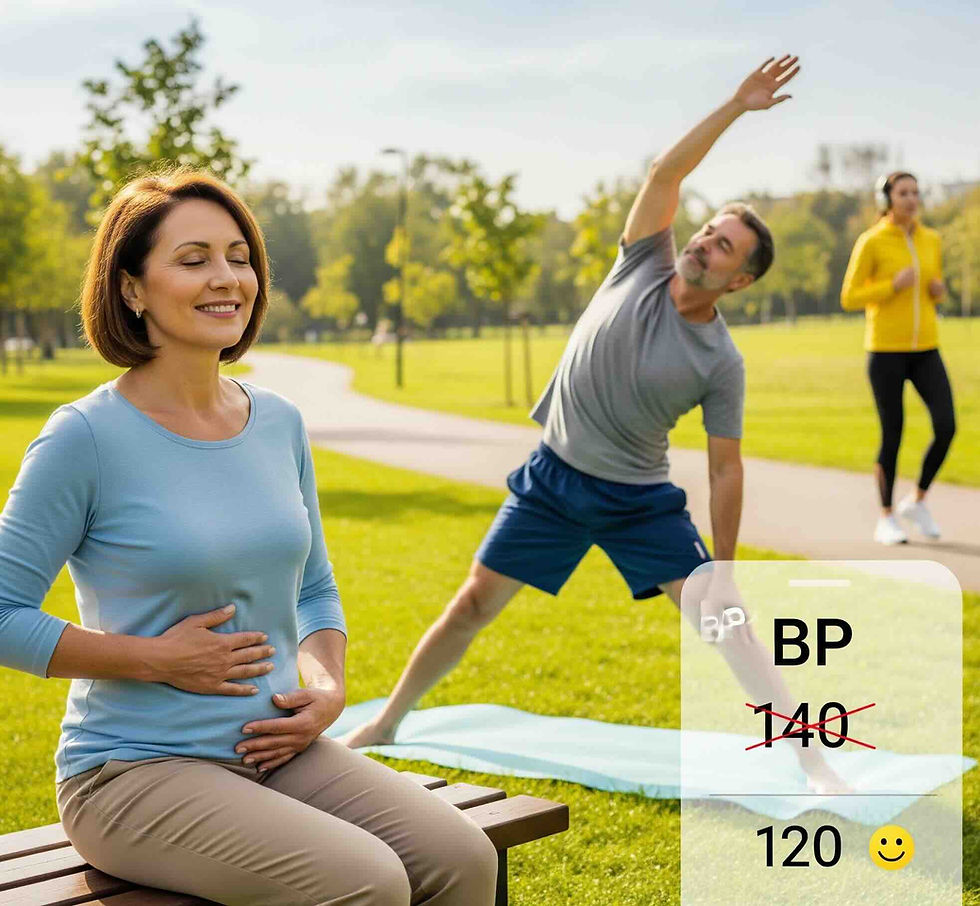
5 Exercises to Lower Blood Pressure

Updated: Oct 6

According to scientific research, exercise is one of the most effective natural tools for lowering high blood pressure. The strongest evidence supports aerobic exercise, isometric exercises and strength training, while stretching and HIIT can also help. The 2025 ACC/AHA hypertension guideline recommends structured aerobic and resistance exercise for preventing and treating elevated blood pressure and hypertension. Read the AHA guidelines here.
📊 5 Exercises to Lower Blood Pressure Compared
Exercise | How to do it | Evidence for lowering BP | Typical session | Main caution |
Aerobic exercise | Brisk walking, cycling, swimming or jogging | ⭐⭐⭐⭐ Strong | 30 min, 5 days/week | Build volume gradually |
Isometric exercises | Wall sits or handgrip holds | ⭐⭐⭐⭐ Strong | ~10–15 min, 3 days/week | Keep breathing; don't strain |
Strength exercises | Weights, resistance bands or bodyweight exercises | ⭐⭐⭐⭐ Strong | 2–3 days/week | Avoid breath-holding and maximal lifts |
Stretching | Slow static stretches for major muscle groups | ⭐⭐⭐ Moderate | 15–30 min, 4–5 days/week | Evidence is emerging |
HIIT | Short harder intervals separated by easy recovery | ⭐⭐⭐ Moderate–Strong | 15–25 min, 1–2 days/week | Progress to HIIT gradually from aerobic |
My practical choice for most beginners: start with brisk walking and add two or three short sessions of strength or isometric training each week.
Most time-efficient exercise with particularly strong BP evidence: isometric exercise such as wall sits or handgrip training. This is also proven by my personal experience.
🔬 What Does the Research Say About Exercise and Blood Pressure?
The 2025 ACC/AHA hypertension guideline specifically recommends increasing physical activity through structured aerobic and/or resistance exercise.
Its evidence review estimates average reductions of approximately:
📉 Aerobic exercise: 4–7 mmHg systolic
📉 Dynamic resistance exercise: about 3 mmHg systolic
📉 Isometric exercise: approximately 8 mmHg systolic
The guideline also notes that BP-lowering effects occur with continuous exercise, interval exercise and both lower- and higher-intensity training. DOI
A large 2023 network meta-analysis of 270 randomized trials reached a similar conclusion. Aerobic exercise, resistance exercise, HIIT and isometric training all reduced resting blood pressure, with isometric exercise producing the largest average reduction in that analysis. PubMed. Different forms of exercise for high blood pressure have different benefits, and the best program is usually one you can perform safely and consistently.
1. 🚶 Aerobic Exercise: Walking, Cycling, Swimming and Jogging
Aerobic exercise is still one of the best places to start if you want an exercise to lower blood pressure.
Examples include:
🚶 Brisk walking🚴 Cycling🏊 Swimming🏃 Light jogging🥾 Hiking💃 Dancing
Why Aerobic Exercise Helps Blood Pressure
Regular aerobic activity improves cardiorespiratory fitness, vascular function and the ability of your blood vessels to dilate.
A 2024 systematic review and dose-response meta-analysis included 34 randomized trials and 1,787 people with hypertension.
The largest reductions occurred around 150 minutes of aerobic exercise per week:
📉 −7.23 mmHg systolic
📉 −5.58 mmHg diastolic
The researchers concluded:
“Aerobic exercise can lead to a large and clinically important reduction in blood pressure”
Evidence strength: ⭐⭐⭐⭐ Strong
Aerobic exercise is supported by decades of randomized studies, meta-analyses and current hypertension guidelines.
⏱️ A Simple Aerobic Exercise Protocol
A practical target is:
30 minutes × 5 days per week
Brisk walking is an excellent starting point.
Aim for an intensity where your breathing is clearly faster but you can still speak in sentences.
2. 🧱 Isometric Exercises for Blood Pressure
Isometric exercises contract muscles while the joint remains relatively still.
Examples include:
🧱 Wall sits
✊ Handgrip exercise
🦵 Static leg holds
💪 Selected static strength holds
Among all the exercise types reviewed here, the evidence for isometric exercises for blood pressure is particularly interesting because the sessions can be short.
What the Research Shows
A major British Journal of Sports Medicine network meta-analysis compared different exercise modalities.
Average resting BP reductions with isometric training were approximately:
📉 −8.24 mmHg systolic
📉 −4.00 mmHg diastolic
The authors concluded:
“Various exercise training modes improve resting blood pressure, particularly isometric exercise.”
The 2025 ACC/AHA hypertension guideline also gives isometric resistance training one of the largest estimated BP effects in its lifestyle table: roughly 5–10 mmHg systolic and 4–6 mmHg diastolic. American Heart Association Journals
Evidence strength: ⭐⭐⭐⭐ Strong
✊ Research-Based Handgrip Protocol
A commonly studied protocol is:
4 × 2-minute contractions
at approximately:
30–40% of maximum voluntary contraction
with:
1 minute of rest between holds
performed:
3 times per week. American Heart Association Journals
Do not hold your breath while squeezing.
For a more detailed explanation of the research and protocols, see our guide:
🧱 What About Wall Sits?
Wall sits are another form of isometric training, and the 2023 network meta-analysis ranked the isometric wall squat particularly highly for systolic BP reduction. PubMed
You do not need to start with a two-minute hold.
Beginners can use a shallower squat and shorter holds, gradually increasing duration as strength improves.
3. 🏋️ Strength Exercises
Strength training is different from static isometric training.
With dynamic resistance exercise, the muscles shorten and lengthen while you move a load through a range of motion.
Examples include:
🏋️ Squats
💪 Rows
🦵 Leg presses
🏋️ Chest presses
🪢 Resistance-band exercises
🪑 Sit-to-stand exercises
What the Research Shows
A large meta-analysis of 84 randomized trials involving 5,065 people with hypertension found that exercise significantly reduced blood pressure and that resistance exercise performed comparably to aerobic exercise.
The authors concluded:
“Resistance exercise has a similar antihypertensive effect to aerobic exercise in hypertensive patients.”
A newer meta-analysis of randomized trials in people with hypertension also found significant reductions with resistance training, although results differed substantially between studies. PMC
Evidence strength: ⭐⭐⭐⭐ Strong
The 2025 ACC/AHA guideline recommends resistance exercise at least two days per week as part of hypertension prevention and treatment. JACC
🏋️ A Practical Strength Routine
Start with 5–6 exercises covering the major muscle groups:
Squat or sit-to-standRowChest press or wall push-upHip hingeShoulder exerciseCalf raise
A practical starting point is:
1–3 sets × 8–12 repetitions
on:
2–3 non-consecutive days per week.
The most important BP-specific rule is:
💨 Keep breathing.
Do not perform prolonged breath-holding or aggressive straining during a lift because blood pressure can rise sharply during heavy exertion. For someone new to high blood pressure exercise, moderate resistance is generally a better starting point than maximal lifting.
4. 🧘 Stretching Exercises
Stretching is less well studied than walking, resistance training or isometric exercise, but the results are intriguing.
Stretching muscles also mechanically stretches the arteries supplying those muscles, and regular flexibility training may influence vascular stiffness and circulation.
What the Research Shows
In a randomized trial, adults with high-normal blood pressure or stage 1 hypertension performed either:
30 minutes of stretching
or
30 minutes of brisk walking
five days per week for eight weeks.
The researchers concluded:
“An 8-week stretching program was superior to brisk walking for reducing blood pressure”
Evidence strength: ⭐⭐⭐ Moderate
🧘 A Simple Stretching Routine
Try approximately 15–30 minutes, focusing on:
HamstringsCalvesQuadricepsHipsChestShouldersUpper back
Hold each position gently for around 20–30 seconds.
Avoid bouncing or forcing the stretch, and continue breathing normally.
For more detail, see:
5. ⚡ HIIT — High-Intensity Interval Training
HIIT alternates relatively hard exercise with easier recovery.
For example:
🚴 1 minute hard cyclingthen🚴 1–2 minutes easy cycling
repeated several times. HIIT is attractive because it can improve fitness in less time than traditional continuous exercise.
What the Research Shows
The evidence for blood pressure is positive but more complicated than some headlines suggest.
A 2025 systematic review of randomized trials in people with hypertension found approximately:
📉 −3.0 mmHg systolic
with HIIT, but no statistically significant average reduction in diastolic BP.
The authors summarized:
“HIIT interventions yield small reductions in SBP, with minimal impact on DBP.”
However, newer 2026 evidence examining 24-hour ambulatory blood pressure is more encouraging.
A network meta-analysis of 31 randomized trials found HIIT reduced 24-hour BP by approximately:
📉 −5.71 mmHg systolic
📉 −4.64 mmHg diastolic
The authors concluded that:
“Aerobic training (continuous and interval) and combined training significantly reduced 24-hour blood pressure.”
Read the 2026 ambulatory-BP exercise meta-analysis on PubMed PubMed
Evidence strength: ⭐⭐⭐ Moderate–Strong
⚡ A Beginner-Friendly HIIT Session
Try:
5-minute easy warm-up
then:
4–6 rounds
of:
30–60 seconds moderately hard
60–120 seconds easy
followed by:
5 minutes easy cool-down.
This is not meant to be an all-out sprint.
For people with uncontrolled hypertension, cardiovascular disease, symptoms during exercise or a long period of inactivity, discuss vigorous interval training with a clinician before starting.
⏱️ How to Lower Blood Pressure Immediately: Does Exercise Work?
People frequently search for “how to lower blood pressure immediately”, but physical exercise needs to be understood correctly.
A single exercise session can produce post-exercise hypotension — a temporary fall in blood pressure during recovery.
Research shows both aerobic and resistance exercise can produce this effect, and in some studies BP remains lower for several hours afterward. PubMed
HIIT can also produce post-exercise hypotension. A meta-analysis found a somewhat greater reduction in daytime ambulatory BP after HIIT than after moderate continuous exercise, although the available studies were limited. PubMed
Exercise is not an emergency treatment for dangerously high blood pressure.
Exercise itself temporarily increases heart rate and blood pressure while you are working.
If you are looking for how to lower blood pressure immediately because a reading is unexpectedly high, first sit quietly, measure again correctly and follow appropriate medical guidance rather than beginning a hard workout.
We discuss the topic separately here:
🏆 Which Exercise Is Best for High Blood Pressure?
There probably isn't one universally best blood pressure exercise.
Based on current evidence, I would think about the five options this way:
🥇 Best overall starting point: Aerobic exercise
Walking is accessible, scalable and backed by extensive research.
🥈 Most time-efficient: Isometric exercises
Handgrip and wall-sit protocols require relatively little time and have produced some of the largest BP reductions in clinical trials.
🥉 Best for strength, muscle and healthy aging: Dynamic strength training
It can lower BP while also helping preserve muscle mass, strength and physical function.
🧘 Best low-intensity addition: Stretching
Promising for BP and vascular health, although the evidence base is smaller.
⚡ Best for improving fitness efficiently: HIIT
Especially useful for people who already have an aerobic base and enjoy higher-intensity exercise.
🔄 Should You Combine Different Blood Pressure Exercises?
Yes. You do not need to choose only one exercise for high blood pressure.
A sensible weekly combination might be:
Aerobic exercise: 150 minutes/week
Strength exercises: 2 days/week
Isometric exercises: 3 short sessions/week
Stretching: several short sessions/week
HIIT: optionally replace one or two aerobic sessions once you have built adequate fitness.
This fits well with the 2025 ACC/AHA recommendation to combine aerobic and resistance activity, and evidence suggests combined exercise programs can be highly effective for BP reduction. JACC
The goal is not to squeeze every technique into every day.
The goal is a program you can maintain for months and years.
🫁 Where Do Breathing Exercises Fit?
Physical exercise and breathing exercises work through partly different mechanisms, so they can complement each other.
Exercise primarily improves:
❤️ cardiovascular fitness
🩸 vascular function
💪 muscle function
⚖️ body composition
🧠 metabolic health
Breathing exercises can additionally target:
😌 autonomic relaxation
🫁 respiratory control
❤️ HRV
🧠 stress
We compared the evidence for five breathing techniques separately:
❤️ How BreathNow Connects Exercise With Blood Pressure
My own experience managing elevated blood pressure helped inspire BreathNow.
The idea is not simply to tell someone:
“Exercise more.”
Instead, BreathNow connects several parts of the process:
🚶 Walking and aerobic exercise
🧱 Guided isometric exercises
🧘 Stretching
⚡ HIIT workouts
🫁 Slow breathing and relaxation
📊 Blood-pressure tracking
⌚ Apple Health and wearable information
🤖 Personalized AI coaching
That makes it easier to see exercise as part of a repeatable blood-pressure improvement plan rather than a one-off workout.
📊 How to Test Whether Exercise Is Lowering Your Blood Pressure
Do not judge an exercise to lower blood pressure from one unusually good reading.
Blood pressure naturally changes throughout the day.
A better personal experiment is:
Measure your blood pressure correctly under similar resting conditions.
Record your baseline averages for at least several days.
Choose a realistic exercise program.
Follow it consistently for 6–12 weeks.
Continue measuring BP under comparable conditions.
Compare weekly or monthly averages rather than your lowest individual reading.
Also track resting heart rate, walking capacity, strength and fitness — exercise may improve cardiovascular health even when BP changes are modest.
If you take antihypertensive medication, continue taking it as prescribed unless your healthcare professional changes your treatment.
🚨 High Blood Pressure Exercise Is Not Emergency Treatment
Do not start vigorous exercise in an attempt to force an extremely high BP reading down.
A reading above 180/120 mmHg, particularly when accompanied by symptoms such as:
❤️ chest pain
😮💨 shortness of breath
🧠 confusion
💪 weakness or numbness
👁️ vision changes
🗣️ difficulty speaking
can require urgent medical assessment.
Regular exercise is a powerful tool for long-term BP management. It should not be confused with emergency treatment for a hypertensive crisis.
❓ Frequently Asked Questions
1. What is the best exercise to lower blood pressure?
Aerobic exercise, isometric exercise and resistance training all have strong evidence for lowering blood pressure. For most beginners, brisk walking is the simplest starting point, while isometric exercises are particularly time-efficient.
2. What are the best isometric exercises for blood pressure?
Wall sits and isometric handgrip training are among the most studied options. Research protocols commonly use several sustained contractions separated by recovery periods while breathing normally.
3. Can walking lower blood pressure?
Yes, regular walking can lower both systolic and diastolic blood pressure. The strongest overall aerobic-exercise benefits appear around 150 minutes of activity per week.
4. Can strength exercises lower blood pressure?
Yes, randomized trials show that dynamic resistance training can reduce blood pressure in people with hypertension. Moderate training performed two or more days per week also provides important benefits for muscle strength and healthy aging.
5. Does stretching lower blood pressure?
Some randomized research suggests regular stretching may reduce blood pressure, and one trial found greater improvements in several BP measures than brisk walking. However, the overall stretching evidence is less extensive and consistent than the evidence for aerobic and resistance exercise.
6. Is HIIT good for high blood pressure?
HIIT can reduce blood pressure and improve cardiovascular fitness, with newer evidence supporting reductions in 24-hour ambulatory BP. People with uncontrolled hypertension or significant cardiovascular risk should obtain appropriate medical guidance before beginning vigorous interval exercise.
7. How quickly does exercise lower blood pressure?
Blood pressure can temporarily fall for several hours following a single exercise session, a phenomenon called post-exercise hypotension. More durable resting BP improvements generally require consistent training over several weeks or months.
8. How much exercise should I do for high blood pressure?
A useful general goal is about 150 minutes of moderate aerobic activity per week plus resistance exercise at least twice weekly. The best amount depends on your health, fitness, medications and previous exercise experience.
9. How can I lower blood pressure immediately with exercise?
Hard exercise should not be used as an emergency method for rapidly lowering a very high BP reading because blood pressure rises during exertion. Regular exercise can create both short-term post-exercise reductions and much more important long-term improvements.
10. Can exercise replace blood pressure medication?
No, exercise should not be used to stop prescribed blood-pressure medication without medical supervision. It is best considered part of a broader hypertension strategy that can include diet, weight management, sleep, stress reduction and medication when indicated.
📚 Research References
1. 2025 ACC/AHA Hypertension Guideline — recommends structured aerobic and/or resistance exercise for adults with or without hypertension and summarizes expected BP reductions across exercise modes. Read the 2025 ACC/AHA guideline DOI
2. Ganjeh et al. — Aerobic Exercise and Hypertension — meta-analysis of 34 randomized trials and 1,787 participants, with the greatest BP reduction around 150 minutes/week. PubMed PubMed
3. Edwards et al. — Exercise Training and Resting Blood Pressure — large network meta-analysis showing significant BP reductions with aerobic, dynamic resistance, combined, HIIT and isometric exercise. PubMed PubMed
4. Resistance Exercise and Hypertension Meta-analysis — 84 randomized trials found resistance exercise produced antihypertensive effects comparable to aerobic exercise in people with hypertension. PubMed PubMed
5. Ko et al. — Stretching vs Walking — randomized trial comparing eight weeks of stretching and brisk walking in adults with high-normal BP or stage 1 hypertension. PubMed PubMed
6. HIIT and Hypertension Meta-analysis — randomized-trial meta-analysis finding a modest reduction in systolic BP following HIIT. PubMed PubMed
7. 2026 Exercise and 24-Hour Ambulatory BP Network Meta-analysis — found reductions in 24-hour BP with aerobic, interval and combined exercise training. PubMed PubMed
Medical disclaimer: This article is for educational purposes and does not replace individualized medical advice. People with uncontrolled hypertension, cardiovascular disease, exercise-related symptoms or significant medical conditions should discuss a new exercise program with their healthcare professional.