Can Stretching Reduce Arterial Stiffness?

What New Research Suggests for Heart Health

Most people think stretching is only about flexibility. You stretch to loosen tight muscles.You stretch after sitting too long.You stretch before or after exercise.
But research suggests that regular stretching may do more than help you move better.
It may also support the health of your blood vessels.

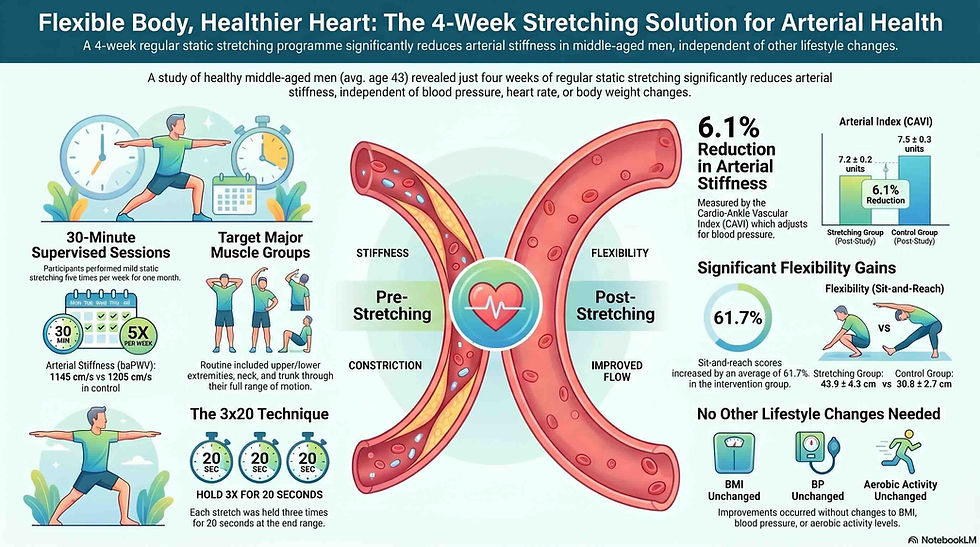
This study found that 4 weeks of regular static stretching reduced arterial stiffness in middle-aged men.
That is an important finding because arterial stiffness is one of the signs of vascular aging. As we get older, our arteries can gradually lose elasticity. When arteries become stiffer, the heart may need to work harder to push blood through the body.
The simple message is this:
Stretching may not only help your muscles feel younger. It may also help your arteries stay more flexible. ❤️
What Is Arterial Stiffness? 🫀
Your arteries are not rigid pipes.
Healthy arteries are elastic. They expand when the heart pumps blood and then gently recoil. This helps blood flow smoothly through the body.
Think of your arteries like a flexible garden hose.
✅ A soft, flexible hose allows water to flow smoothly.
❌ A stiff hose creates more pressure and resistance.
The same idea applies inside the body.
When arteries become stiffer, blood flow may become less efficient. Arterial stiffness is also linked with aging and cardiovascular risk.
It does suggest that stretching may be a useful part of a heart-healthy lifestyle — especially when combined with walking, breathing exercises, strength training, good sleep, and healthy nutrition.
What Did the Study Find? 🔬
The study looked at healthy middle-aged men.
One group performed regular static stretching for 4 weeks.Another group continued their usual lifestyle.
The stretching sessions included major muscle groups and were performed regularly under supervision.
After 4 weeks, the stretching group showed two important changes:
✅ Better flexibility
✅ Lower arterial stiffness
In simple terms:
The people who stretched regularly became more flexible — and their arteries appeared to become more flexible too.
This is the key concept of the study.
Stretching is usually seen as a muscle habit.But the body is connected.
When you stretch muscles, you also affect surrounding tissues, circulation, blood vessels, and possibly the nervous system.
That may explain why a simple stretching routine can sometimes feel relaxing, calming, and restorative — not just physically, but also mentally.
Why Could Stretching Help Your Blood Vessels? 🤔
Researchers are still studying the exact mechanisms, but there are a few likely explanations.
1. Stretching may stimulate blood vessels 🩸
When you stretch a muscle, you also stretch nearby tissues and small blood vessels.
This gentle mechanical stimulation may help blood vessels adapt and function better over time.
2. Stretching may improve circulation 🌿
Stretching can increase local blood flow and reduce muscular tension.
Better movement, less stiffness, and improved circulation may all support healthier vascular function.
3. Stretching may calm the nervous system 😌
Slow stretching often encourages slower breathing and relaxation.
This may help the body shift away from “fight or flight” mode and toward a calmer state.
That matters because stress can influence heart rate, blood pressure, sleep, and recovery.
This is why stretching before bed or after a stressful day can feel so powerful.
It sends a simple signal to your body:
Slow down. Breathe. Relax. Recover.
3 Practical Ways to Use This Research in Everyday Life 🌞
You do not need to copy the exact study protocol to benefit from the idea.
The most useful approach is to turn stretching into a simple habit you can repeat consistently.
Here are 3 practical ways to start.
1. Build a 10-Minute Daily Stretching Routine 🧘♂️
Start small.
You do not need a 30-minute session.You do not need advanced yoga.You do not need perfect flexibility.
A simple 10-minute routine is enough to begin.
Focus on large muscle groups:
🦵 Calves
🦵 Hamstrings
🦵 Hip flexors
🦵Quadriceps
🧍 Chest and shoulders
🧘 Lower back
Hold each stretch for 20–30 seconds.
The stretch should feel comfortable. You should feel mild tension, not pain.
A simple daily routine could look like this:
Calf stretch — 30 seconds each side
Hamstring stretch — 30 seconds each side
Hip flexor stretch — 30 seconds each side
Chest-opening stretch — 60 secondsLower back stretch — 60 seconds
Neck and shoulder stretch — 60 seconds
The goal is not to become extremely flexible.
The goal is to give your body a daily dose of gentle movement, circulation, and relaxation.
2. Combine Stretching With Slow Breathing 🫁
Stretching becomes even more powerful when you pair it with calm breathing.
During each stretch, try this simple pattern:
Inhale gently through your nose.Exhale slowly.Relax your shoulders.Let your jaw soften.Allow your body to release tension gradually.
A useful breathing rhythm is:
Inhale for 4 seconds.Exhale for 6 seconds.
This longer exhale may help your body settle into a calmer state.
You can use this combination at different times of the day:
🌞 Morning — to start the day gently
💻 Midday — to reset after sitting
🚶 After walking — to cool down
🌙 Evening — to relax before sleep
📱 Before checking blood pressure — to avoid measuring while rushed or tense
This is where BreathNow app can fit naturally into your routine.
BreathNow includes guided breathing exercises and follow-along wellness videos that can help you turn stretching into a structured relaxation habit.
For example, you can do:
🧘 7–10 minutes of stretching
🫁 3 minutes of slow breathing in BreathNow
❤️ Then track how your heart rate, HRV, or blood pressure trends respond over time
This helps you move from guessing to learning.
You may notice that stretching plus slow breathing helps you feel calmer, sleep better, or recover faster after a stressful day.
3. Track Your Response with BreathNow app and Find What Works for You 📲❤️
Everyone responds differently.
Some people feel best after stretching.Some respond better to walking.Some benefit most from slow breathing.Others feel a strong effect from isometric exercises like wall sits, planks, or handgrip training.
The best routine is the one that works for your body — and the one you can repeat.
BreathNow can help with this because it is designed to connect daily habits with cardiovascular signals.
You can use it to track:
✅ Blood pressure trends
✅ Heart rate
✅ HRV
✅ Stress-related changes
✅ How you feel before and after different activities
You can also explore follow-along videos for breathing, relaxation, stretching, walking, and simple exercises.
A practical experiment could be:
Week 1
Do 10 minutes of stretching 5 days per week.
Week 2
Add 3 minutes of slow breathing after stretching.
Week 3
Try stretching before bed and notice whether sleep or morning readings feel different.
Week 4
Compare stretching with another activity, such as walking or a guided breathing session.
Over time, you can ask your AI coach in the BreathNow app better questions:
❤️ Which habit helps my heart rate settle?
🫁 Which routine makes me feel calmer?
📉 What supports better HRV?
🫀 What helps my blood pressure trend in the right direction?
🔁 Which routine can I realistically keep doing?
This is the practical value of tracking.
Not every single reading matters.The trend matters.
And the trend can help you understand which daily habits are actually helping you.
Frequently Asked Questions (FAQ)
1. Can stretching really improve artery health?
Research suggests that regular stretching may help reduce arterial stiffness, a marker associated with vascular aging. While stretching is not a treatment for heart disease, it may be a useful addition to a heart-healthy lifestyle.
2. What is arterial stiffness?
Arterial stiffness refers to a loss of elasticity in the arteries, making it harder for blood vessels to expand and contract efficiently. Higher arterial stiffness is associated with aging and an increased risk of cardiovascular problems.
3. How much stretching did participants perform in the study?
The participants performed regular static stretching sessions five times per week for four weeks. Each session included stretches for major muscle groups and lasted about 30 minutes.
4. How long should I stretch each day?
You do not need to follow the exact study protocol to benefit from stretching. For most people, a consistent 10-minute daily stretching routine is a practical and sustainable starting point.
5. Which muscles should I focus on stretching?
The study targeted major muscle groups, particularly in the lower body. A balanced routine should include the calves, hamstrings, hip flexors, quadriceps, lower back, chest, and shoulders.
6. Is stretching enough to lower blood pressure?
Stretching alone should not be viewed as a substitute for medical treatment or other healthy habits. The best results typically come from combining stretching with regular exercise, healthy nutrition, good sleep, and stress management.
7. Why does stretching often feel relaxing?
Stretching is usually performed slowly and is often paired with calm breathing, which may help reduce stress and muscle tension. This combination can encourage the body to shift into a more relaxed state and support recovery.
8. Can stretching improve flexibility at any age?
Yes, people can improve flexibility at almost any age with regular practice. Consistency is more important than intensity, and even small improvements can make everyday movement feel easier.
9. Should I combine stretching with breathing exercises?
Combining stretching with slow, controlled breathing can make the experience more relaxing and enjoyable. Many people find that stretching and breathing together help them feel calmer and more focused.
10. How can BreathNow app help me build a stretching habit?
BreathNow provides guided breathing exercises, follow-along wellness videos, and tools for tracking cardiovascular trends such as blood pressure, heart rate, and HRV. This can help you understand how stretching and other healthy habits affect your body over time.